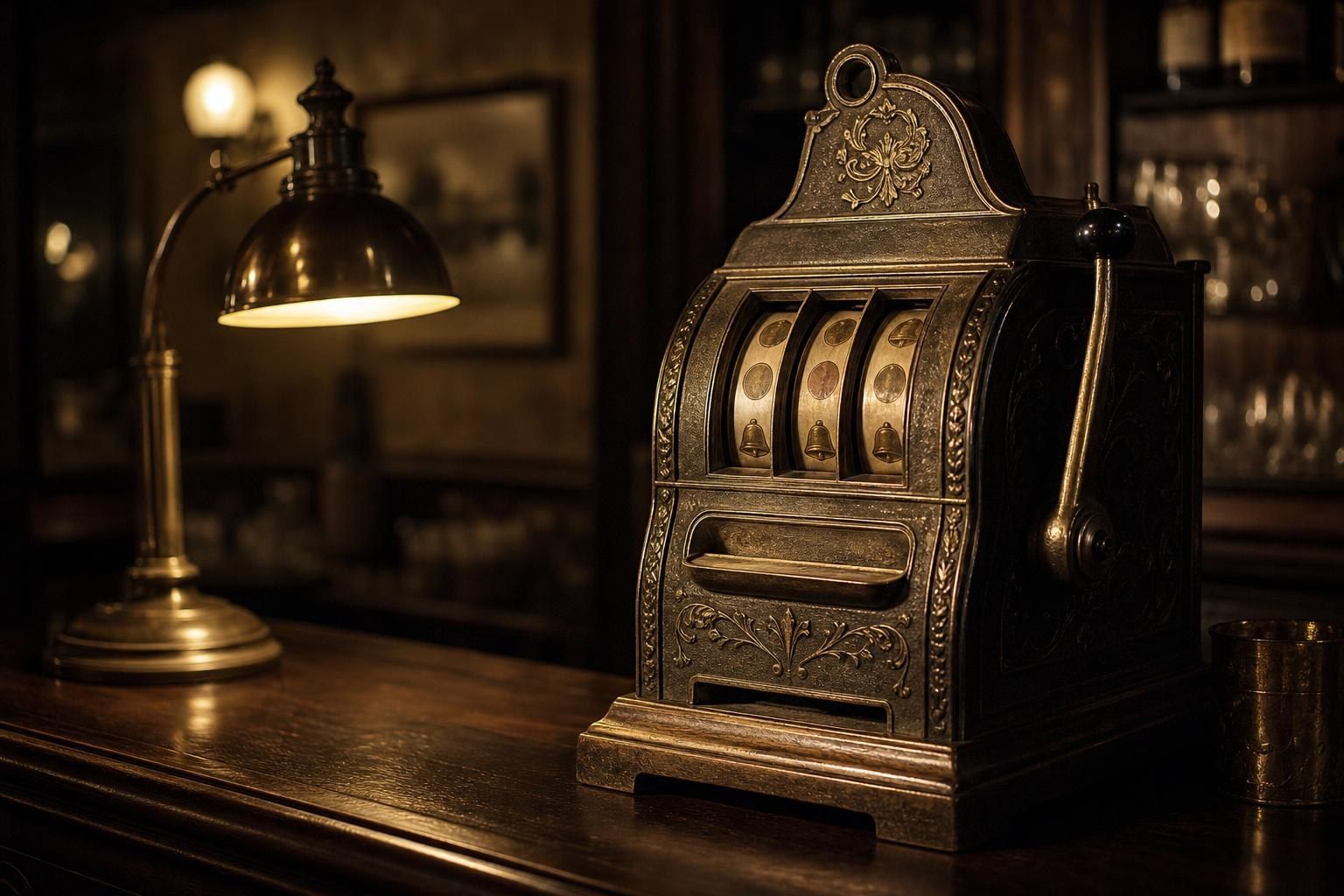
Nobody agrees on the exact year the slot machine was born, which is a fitting start for a game built on uncertainty. What the histories do agree on is the place: a small workshop in San Francisco, a man called Charles August Fey, and a coin-operated box with three reels and a bell painted on them.
The history of the slot machine since then is mostly a story about the same idea being rebuilt in new materials. Springs and cogs gave way to motors and screens, and the screens eventually moved into our phones. The basic promise, put a coin in and watch symbols line up, has hardly changed in 130 years.
Charles Fey's workshop on Market Street
Before Fey, there were gambling machines, but they were clumsy. Wikipedia's slot machine history points to an 1893 design by Sittman and Pitt of Brooklyn, which used five drums carrying 50 playing card faces. It was really a poker game in a cabinet, and a royal flush might be paid in cigars or drinks by the bar, because the machine had no way of working out every possible hand and paying it.
Fey's answer was to make the game simpler. He cut it down to three reels and five symbols: horseshoes, diamonds, spades, hearts and a Liberty Bell. With so few combinations, the mechanism itself could read the result and drop the coins. The bell gave the machine its name.
The dates are where it gets messy. California's Office of Historic Preservation says Fey invented the first coin-operated, three-reel slot machine in San Francisco in 1895. Encyclopaedia Britannica puts the Liberty Bell itself at 1899, after an earlier machine called the Card Bell. Wikipedia hedges with "between 1887 and 1895". The fairest reading is that the three-reel bell machine took shape in the second half of the 1890s and the Liberty Bell name stuck to it.
The state landmark adds one detail I find more interesting than the date. Fey built his Liberty Bell machines at 406 Market Street from 1897 until the 1906 earthquake and fire destroyed the workshop. The plaque now sits on a traffic island on Market Street between Bush and Battery Streets, which is about as unglamorous a monument as an invention this famous could have.
How fruit and chewing gum ended up on the reels
Fey did not keep the idea to himself for long. The manufacturer Herbert Mills produced his own version in 1907, and it was also sold as a "Liberty Bell". Copies and variations spread quickly, and so did legal trouble, because paying out cash from a machine in a bar was illegal in plenty of places.
The workaround is why so many slots still show cherries and lemons. One model, the Operator's Bell, offered an optional gum-vending attachment. The gum was fruit flavoured, so lemons, cherries, oranges and plums went on the reels to match. The bar symbol, which you will still find on classic slots today, traces back to a stick of Bell-Fruit Gum pictured on the machine.
British players will recognise the result straight away. The fruit machine in a pub is a direct descendant of these American gum machines, which is why a game with no connection to fruit at all can still be called one.
Bally's Money Honey and the electric hopper
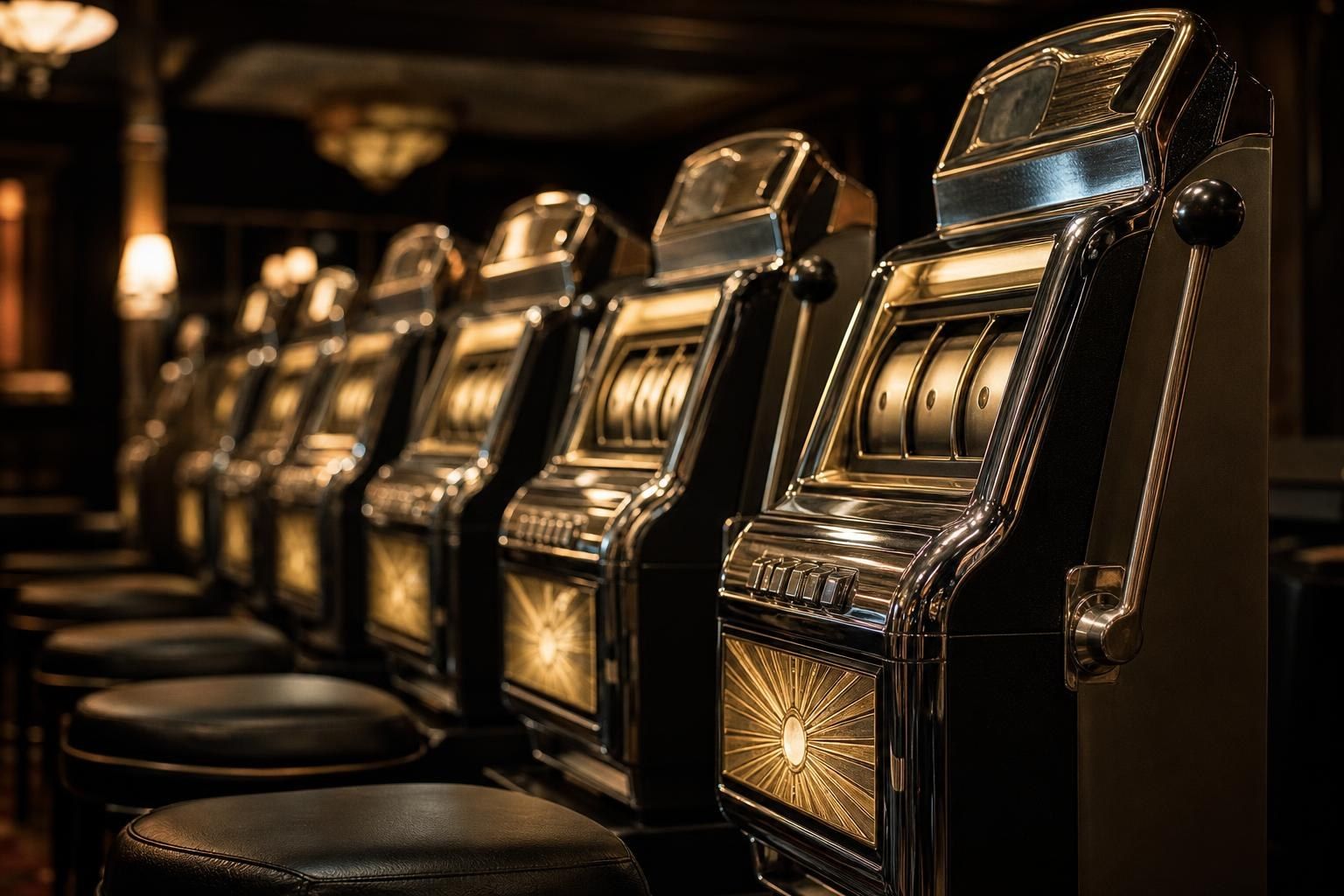
For half a century, slots stayed mechanical. The reels were spun by a lever and stopped by brakes, and the payout was limited by how many coins the mechanism could release at once. That is also where the "one-armed bandit" nickname comes from: the arm was the lever, and the rest needs no explaining.
The step change came from Bally. Its Money Honey is usually described as the first fully electromechanical slot machine, and its real novelty was the hopper: a coin reservoir that could pay out up to 500 coins automatically, without an attendant. That made much bigger prizes practical, and big prizes changed what people expected from a slot.
The year depends on who you ask. Wikipedia gives 1963, while Wikipedia's own article on Bally Manufacturing, like most collector sources, gives 1964. Some collectors also dispute the word "first", since electromechanical machines had been built elsewhere before. What nobody disputes is the effect: its success pushed the industry towards electronic games, and the side lever soon became little more than decoration.
When the reels became a television screen
The next jump was stranger than it sounds. In 1976 the Las Vegas based Fortune Coin Co. built the first video slot in Kearny Mesa, California. Instead of physical reels, it used a modified 19-inch Sony Trinitron colour receiver as the display, with logic boards running all the slot functions.
Players did not trust it at first. A screen could show anything, and a reel you could see spinning felt more honest. The first production units went on trial at the Las Vegas Hilton Hotel, and the Nevada State Gaming Commission approved the machine only after modifications to defeat cheating attempts. In 1978 Fortune Coin and its video slot technology were bought by IGT (International Gaming Technology).
The video slot mattered for a reason that only became obvious later. Once the reels were pictures, a designer was no longer limited by how many symbols fit on a metal band. Bonus screens, extra reels and themes borrowed from films and TV all depend on that 1976 decision. If you have read our piece on movie-themed online slots, every game in it is a grandchild of the Fortune Coin cabinet, and so is every game in our round-up of TV and music themed slots.
The move online in the mid-1990s
Two things had to happen before slots could leave the building. Somebody had to license online casinos, and somebody had to write the software. In 1994 Antigua and Barbuda passed the Free Trade and Processing Act, which allowed licences to be granted to companies wanting to open online casinos. In the same period, Microgaming, a software company based on the Isle of Man, is credited with developing the first fully functional online gambling software.
Growth was fast but started from almost nothing. One estimate quoted in Wikipedia's history of online gambling counts 15 gambling websites in 1996 and around 200 a year later. For a sense of how people gambled before any of this, our look at gambling life before the internet covers the betting shops and casino clubs that came first.
Megaways and the reel that changes every spin
For a long time, online slots kept the old grid: five reels, three rows, a fixed number of paylines. The most influential break from that came from Big Time Gaming, a studio founded in Sydney in 2011, at the start of 2016. Its game Dragon Born introduced a mechanic called Megaways, in which every reel shows a random number of symbols on each spin, so the number of ways to win changes every time. At its maximum, the count reaches 117,649.
Dragon Born did not take off. Bonanza, a gold-mining game released in December 2016, did. Big Time Gaming's own page for Bonanza lists the same maximum of 117,649 ways and an RTP of 96.00%, and the game's success is what turned Megaways from a curiosity into a format other studios licensed and copied.
The UK rules around these games have moved too. Since 31 October 2021, Gambling Commission rules have required at least 2.5 seconds per spin on online slots and banned autoplay and turbo or "slam stop" features. Stake limits followed: a £5 maximum per spin for all adults from 9 April 2025, and £2 for 18 to 24 year olds from 21 May 2025. Fey's Liberty Bell paid ten nickels for three bells. A Megaways spin in Britain today is capped by statute, played by adults only (18+), and regulated by a body whose rulebook would have baffled him.
One thing would not have baffled him. On a video slot the result is settled by the random number generator the moment you press the button, yet the reels still stop one after another, left to right, as if a brake were catching each one. That bit of theatre is pure 1890s.
Frequently asked questions
Who invented the slot machine?
Charles August Fey, working in San Francisco, is credited with the first coin-operated three-reel slot machine with automatic payouts. Earlier gambling machines existed, such as the Sittman and Pitt poker machine of 1893, but they could not pay winnings out on their own.
When was the Liberty Bell slot machine made?
Sources differ. California's historic landmark record dates Fey's three-reel machine to 1895, Britannica dates the Liberty Bell to 1899, and Fey's Market Street workshop produced the machines from 1897 until the 1906 earthquake.
Why do slot machines have fruit symbols?
Early machines got around gambling laws by dispensing fruit-flavoured chewing gum. The reels showed cherries, lemons, oranges and plums to match the flavours, and the bar symbol comes from a Bell-Fruit Gum logo.
What was the first Megaways slot?
Big Time Gaming's Dragon Born, released at the start of 2016, was the first. Bonanza, released in December 2016, made the mechanic popular. Both offer up to 117,649 ways to win.